

Artificial intelligence and high-performance computing are changing how data centers manage heat. As rack densities increase, many facilities are adding direct-to-chip liquid cooling, coolant distribution units and other liquid-based thermal-management systems.
These systems can remove heat more effectively from high-density computing equipment, but they also introduce a network of pumps, filters, valves, heat exchangers, piping and controls that must operate within defined conditions.
Operators need more than cooling capacity. They need reliable information about what is happening throughout the cooling loop.
Pressure, temperature and differential-pressure instrumentation provides that visibility. By measuring conditions at critical points, operators can identify abnormal changes, evaluate cooling performance and address developing problems before they affect equipment availability.
Hydraquip helps data center owners, engineering firms, contractors and equipment manufacturers select and integrate instrumentation for liquid cooling applications. Through its partnership with NOSHOK, Hydraquip can support pressure and temperature measurement requirements with a broad range of industrial instrumentation solutions.
What Is Data Center Cooling Instrumentation?
Data center cooling instrumentation includes the sensors, transmitters, switches, gauges and related devices used to measure operating conditions within a cooling system.
Depending on the system design, these instruments may be installed on:
- Coolant distribution units
- Facility and technology cooling loops
- Pump suction and discharge lines
- Supply and return headers
- Filters and strainers
- Heat exchangers
- Rack manifolds
- Reservoirs or expansion vessels
The measurements are typically sent to a CDU controller, programmable logic controller, building automation system or remote I/O system. Selected values and alarms may then be shared with building management or data center infrastructure management platforms.
Instrumentation does not control the cooling process by itself. It gives the control system and facility team the information needed to understand system conditions and respond appropriately.
Why Instrumentation Matters in Liquid-Cooled Data Centers
A liquid cooling system depends on several components working together. Pumps circulate coolant, valves regulate distribution, filters protect sensitive passages and heat exchangers transfer heat between cooling loops.
A change in one part of the system can affect performance elsewhere.
For example:
- A plugged filter element may increase cooling loop pressures and reduce available flow.
- Pump wear may reduce discharge pressure.
- An improperly positioned valve may alter coolant distribution.
- Heat-exchanger fouling may reduce thermal performance.
- A change in supply or return temperature may indicate an operating or load condition that requires investigation.
Pressure and temperature data help operators recognize these changes. However, measurements must be considered together. Pressure alone does not verify that every cold plate or server receives the required coolant flow, and temperature alone does not identify the cause of reduced performance.
A complete monitoring strategy may also include flow, level, coolant cleanliness and dedicated leak detection.
Pressure Monitoring in Data Center Cooling Systems
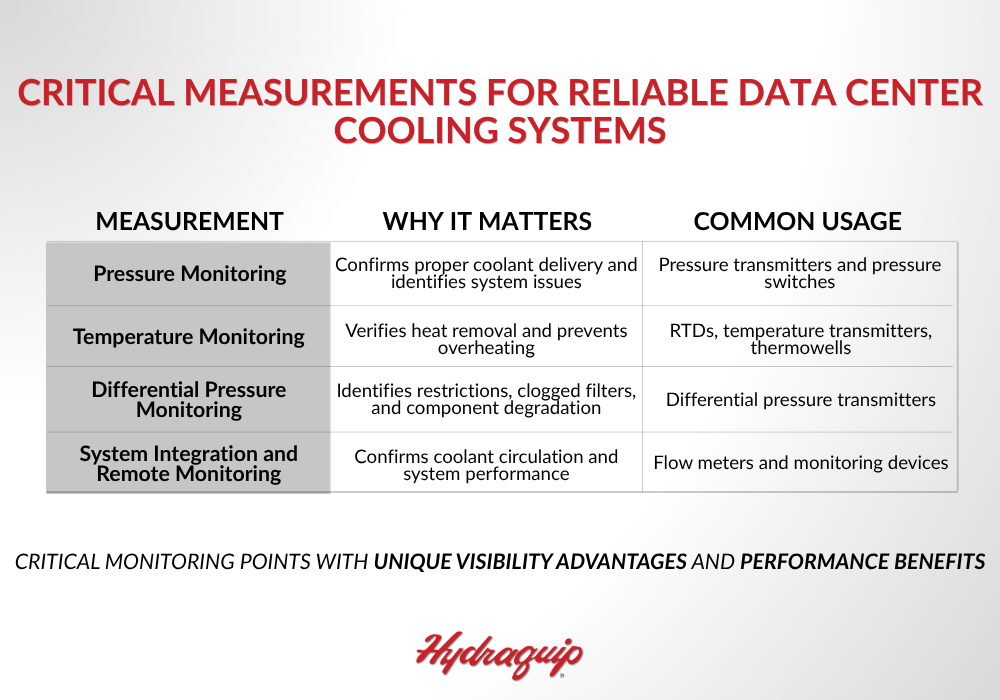
Pressure monitoring helps operators evaluate whether the cooling loop is operating within its intended range.
Common pressure measurement points include:
- Pump suction and discharge
- CDU supply and return connections
- Facility and technology cooling loops
- Rack or row distribution headers
- Heat-exchanger connections
- Filter inlet and outlet lines
Unexpected pressure changes can indicate several possible conditions, including pump degradation, a restriction, a valve-position issue, loss of system charge or a significant leak. Because multiple problems can produce similar pressure changes, operators should evaluate pressure readings alongside flow, temperature, valve status and system design information.
Pressure Transmitters
Pressure transmitters provide a continuous output that can be connected to a CDU controller, PLC or facility control system. This allows operators to monitor pressure remotely, trend readings over time and generate alarms when values move outside established limits.
NOSHOK offers industrial pressure transmitters with multiple pressure ranges, output options, process connections and electrical connections. Available product families include general-purpose and higher-accuracy options that may be considered based on the application’s operating range, required accuracy and control-system requirements.
For example, NOSHOK’s PT Series includes fixed-range industrial pressure transmitters with current or voltage output options and multiple connection configurations. Product selection should be based on the actual coolant, pressure range, wetted-material requirements, electrical interface and installation environment.
Pressure Switches
A pressure switch provides a discrete signal when pressure reaches a defined setpoint. It may be used for functions such as:
- Low-pressure alarms
- High-pressure alarms
- Pump protection
- Interlock conditions
- Backup alarm points
A transmitter is generally used when continuous measurement and trending are needed. A switch is better suited to a defined alarm or control point. Some systems may use both.
Temperature Monitoring in Liquid Cooling Loops
Temperature measurements help operators understand whether heat is being collected and transferred as intended. Temperature measurements can also be used to identify a problem area in a cooling system.
Important monitoring points may include:
- CDU secondary-loop supply temperature
- CDU secondary-loop return temperature
- Facility-water inlet and outlet temperature
- Heat-exchanger inlet and outlet temperature
- Rack-manifold supply and return temperature
- Coolant reservoir temperature
Comparing supply and return temperatures provides useful information about heat pickup across a defined part of the system. However, the temperature difference should be evaluated with flow and load data. A change in temperature differential does not automatically identify a fault.
RTDs and Temperature Transmitters
Resistance temperature detectors, commonly called RTDs, are widely used when stable and repeatable temperature measurement is required.
NOSHOK’s temperature portfolio includes probe-type RTDs, RTD transmitters, compact temperature transmitters and electronic temperature transmitter-switches. NOSHOK’s 920 Series RTD transmitter, for example, provides a two-wire, loop-powered 4–20 mA output and is designed for use with a PT100 RTD input.
The appropriate solution depends on:
- Required temperature range
- Desired accuracy
- Probe length and diameter
- Response-time requirements
- Process connection
- Electrical output
- Control-system interface
- Environmental conditions
Compact temperature transmitters may be useful for OEM equipment or CDU packages where installation space is limited. RTD assemblies with connection heads may be more appropriate where the sensor requires added environmental protection or accessible field wiring.
Thermowells
A thermowell creates a protective barrier between a temperature sensor and the coolant. It can allow the sensing element to be removed or replaced, while also preventing any coolant to leak or be spilled.
That can simplify maintenance, but a thermowell should not be selected only for convenience. Its material, insertion length, process connection, wall thickness and response characteristics must match the application.
An oversized or improperly positioned thermowell can slow response or produce a temperature reading that does not accurately represent the coolant condition.
NOSHOK offers threaded, socket-weld, weld-in and flanged thermowell configurations. The appropriate design should be selected based on the piping arrangement, operating conditions and service requirements.
Differential Pressure Across Filters and Heat Exchangers
Differential pressure is the difference between pressure measured at two points. In data center cooling systems, it is commonly used to evaluate pressure drop across a component.
Potential monitoring locations include:
- Filters
- Strainers
- Heat exchangers
- Valves
- Defined sections of a CDU or distribution loop
As a filter collects contamination, pressure drop across the filter increases. A rising pressure differential can indicate that the filter is approaching its service limit, although the alarm threshold should be established using the filter manufacturer’s data and the system’s operating flow.
Differential pressure can also help operators evaluate changes in heat-exchanger pressure loss or identify an unexpected restriction within a defined section of the loop.
NOSHOK offers piston- and diaphragm-type differential-pressure gauges designed for applications such as monitoring pressure drop across filters, strainers, separators, valves and pumps. Where remote monitoring is required, the system designer may instead use a differential-pressure transmitter or calculate the difference between two properly selected pressure transmitters.
The best method depends on the required accuracy, control architecture, pressure range and maintenance strategy.
Pressure Monitoring Is Not a Substitute for Leak Detection
A large or rapid coolant loss may produce an abnormal pressure reading. Small or localized leaks, however, may not create a clear pressure change at the monitoring point.
For that reason, pressure instrumentation should not be treated as a replacement for dedicated leak detection around racks, manifolds, hose connections, CDUs and other areas where coolant could reach sensitive equipment.
A comprehensive monitoring strategy may combine:
- Pressure measurement
- Temperature measurement
- Flow measurement
- Coolant-level monitoring
- Fluid-condition monitoring
- Point or cable-style leak detection
Each measurement provides a different part of the operating picture.
How Instrumentation Connects to Data Center Controls
Most industrial transmitters produce an electrical output that connects to a CDU controller, PLC, building automation controller or remote I/O system.
The controller can then use the measurement to:
- Display current operating conditions
- Generate high or low alarms
- Trend historical performance
- Support pump or valve control
- Assist with troubleshooting
- Share selected data with a BMS or DCIM platform
NOSHOK pressure transmitters are available with several current and voltage output options, including widely used 4–20 mA configurations. Product-specific communication capabilities should be verified during selection rather than assumed across the entire product line.
The electrical output must also be compatible with the control system’s available inputs, power requirements and wiring architecture.
Selecting Instrumentation for a Data Center Cooling Application
Selecting an instrument based only on pressure range or connection size can lead to poor performance or reduced service life.
The selection process should consider:
1. Coolant compatibility
Wetted materials, seals and process connections must be compatible with the specified heat-transfer fluid and its additives. Compatibility should be verified for the actual coolant formulation rather than assumed from the term “water based.”
2. Measurement range
The normal operating range should fall within a useful portion of the instrument span. Startup conditions, shutdown conditions, pump transitions and potential pressure spikes should also be considered.
3. Accuracy and response
The required accuracy should be based on how the measurement will be used. A basic alarm point may not require the same performance as a measurement used for detailed system analysis or control.
4. Process connection
The connection must match the piping or equipment design and allow proper sensor placement without creating an unnecessary restriction, trapped air pocket or maintenance problem.
5. Electrical interface
The output signal, connector, power requirements and environmental rating should align with the CDU or facility control architecture.
6. Serviceability
The installation should allow access for inspection, calibration or replacement. Isolation valves, such as NOSHOK manifold valves, or thermowells may improve serviceability when appropriately designed for the application.
Where NOSHOK Solutions May Fit in the Cooling Loop
Depending on the system design, NOSHOK instrumentation may support several measurement points:
- Pump suction and discharge: Pressure transmitters can help operators monitor pump operating conditions and recognize abnormal pressure changes.
- Cooling-loop supply and return: Pressure and temperature transmitters can provide continuous data to the CDU or facility control system.
- Filters and strainers: Differential-pressure gauges or pressure measurements taken on both sides of the component can help identify increasing restriction.
- Heat exchangers: Pressure and temperature measurements at the inlet and outlet can support evaluation of pressure loss and thermal performance.
- Local equipment indication: Gauges and digital indicators can provide technicians with a local reading during startup, inspection or troubleshooting.
- Temperature measurement points: RTDs, temperature transmitters and thermowells can be configured for the required piping, temperature range and control interface.
These are application examples, not universal specifications. Every instrument must be selected and verified for the actual loop conditions.
How Hydraquip Supports Data Center Cooling Instrumentation
Instrumentation performs best when it is selected as part of the complete cooling system rather than treated as an isolated component.
Hydraquip works with customers to evaluate:
- Measurement objectives
- Sensor and transmitter locations
- Pressure and temperature ranges
- Coolant and wetted-material compatibility
- Process and electrical connections
- Control-system requirements
- Installation and maintenance access
- Related valves, filtration and fluid-conveyance components
This system-level approach helps prevent common selection problems, such as choosing an unsuitable range, using incompatible materials or installing a sensor where it cannot produce a representative measurement.
By combining fluid-system experience with NOSHOK pressure and temperature instrumentation, Hydraquip can help customers develop monitoring solutions for new CDUs, data center cooling infrastructure and existing system upgrades.
Build Greater Visibility into Your Cooling System
As liquid cooling becomes more common in AI and high-density data centers, operators need dependable information from throughout the cooling loop.
Pressure, temperature and differential-pressure measurements help facility teams understand system conditions, identify abnormal changes and make better maintenance decisions. When combined with flow, pressure, temperature, coolant-quality and leak-detection data, this instrumentation provides a more complete view of cooling-system health.
Hydraquip can help identify and integrate NOSHOK instrumentation based on the operating conditions, coolant, control architecture and maintenance requirements of your application.
Contact Hydraquip to discuss pressure and temperature instrumentation for your next data center cooling project.
Frequently Asked Questions
What measurements are important in a data center liquid cooling system?
Important measurements may include pressure, temperature, flow, differential pressure, coolant level, fluid condition and leak status. The exact requirements depend on the CDU, piping architecture, cooling technology and facility control strategy.
What is the difference between a pressure transmitter and a pressure switch?
A pressure transmitter provides a continuous electrical output that represents the measured pressure. A pressure switch changes state when pressure reaches a defined setpoint and is commonly used for alarms or interlocks.
Can pressure sensors detect coolant leaks?
A significant leak may cause an abnormal pressure change, but pressure measurement cannot reliably detect every leak. Dedicated leak detection should be used near racks, manifolds, hoses, CDUs and other areas where a small coolant release could damage equipment.
Why measure differential pressure across a filter?
Differential pressure indicates the pressure drop between the filter inlet and outlet. An increasing differential pressure may indicate contaminant loading or restriction. The maintenance threshold should be based on the filter manufacturer’s recommendations and the system’s operating conditions.
Why are RTDs used in liquid cooling systems?
RTDs provide stable and repeatable temperature measurement. They can be installed at supply, return and heat-exchanger measurement points to help operators evaluate cooling-loop temperatures.
What is the purpose of a thermowell?
A thermowell protects the temperature sensor from the process fluid and allows the sensor to be removed without draining the system. It must be properly sized and installed to maintain acceptable response and measurement accuracy.
Can NOSHOK instruments connect to a CDU control system?
Many NOSHOK pressure and temperature transmitters are available with standard current or voltage outputs that can be connected to compatible CDU controllers, PLCs or remote I/O systems. The exact output, wiring, power and input requirements should be verified for the selected product and control platform.