

As industrial electrical systems become more powerful, compact, and connected, thermal management has become increasingly important. When evaluating liquid cooling vs. air cooling for VFDs, power electronics, control panels, automation systems, and high-density equipment, choosing the right cooling method can directly impact reliability, efficiency, and equipment lifespan. Understanding the advantages and limitations of each approach helps engineers and facility managers select the best solution for their specific operating environment.
In most industrial environments, thermal management comes down to two common methods: air cooling and liquid cooling. While both are effective, the right choice depends on heat load, equipment density, environmental conditions, and long-term operating requirements.
At Hydraquip Electric Systems, cooling system design is part of a broader approach to electrical integration and industrial power solutions. Our team helps customers evaluate their application, operating environment, equipment layout, and performance goals to determine which cooling method makes the most sense.
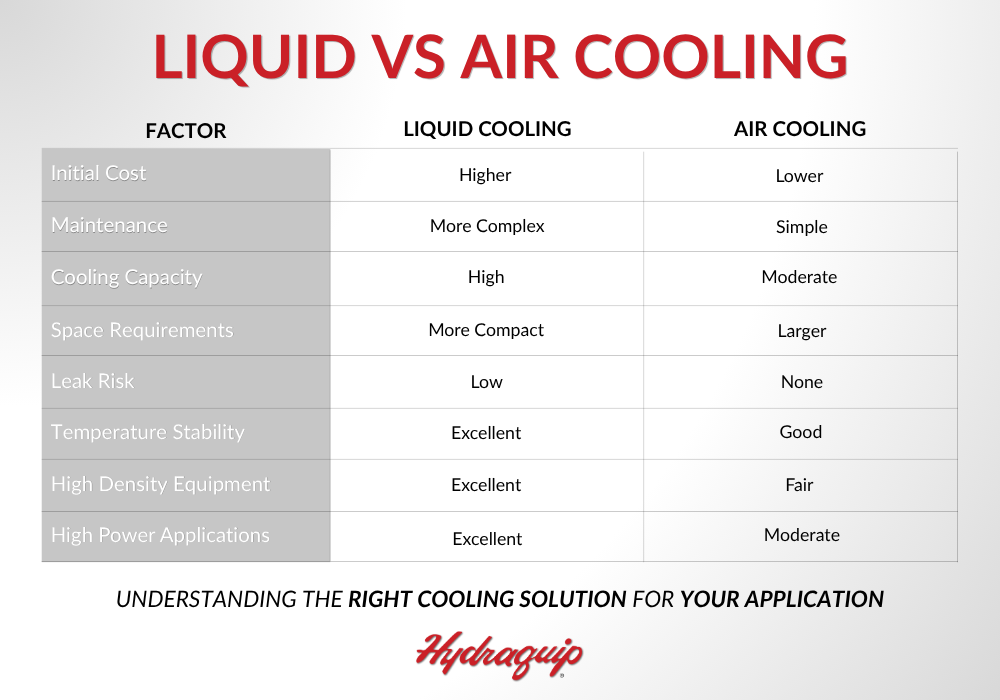
What Is the Difference Between Liquid Cooling and Air Cooling?
The main difference between liquid cooling and air cooling is how each method transfers heat away from electrical equipment.
Air cooling uses fans, ventilation, heat sinks, and ambient air to move heat away from components or electrical enclosures.
Liquid cooling uses coolant, cold plates, cooling loops, or heat exchangers to transfer heat away from high-power or high-density components more efficiently.
Both methods can be effective. The right choice depends on heat load, available space, environmental conditions, system complexity, maintenance expectations, and long-term operating goals.
What Is an Air-Cooled System?
An air-cooled system removes heat by moving air across electrical components, heat sinks, or heat exchangers. Fans, vents, filters, and enclosure ventilation are commonly used to move warm air away from the equipment and bring cooler air into the system.
Air cooling is one of the most common thermal management methods because it is simple, familiar, and cost-effective. Many maintenance teams are already comfortable working with fan-based cooling systems, which can make installation and service more straightforward.
Air-cooled systems are commonly used to protect:
- Industrial control panels
- VFDs and motor starters
- PLC cabinets
- General automation systems
- Manufacturing equipment
- Standard electrical enclosures
- Lower to moderate heat-load applications
Advantages of Air-Cooled Systems
Air cooling remains a strong solution for many industrial applications, especially when the heat load is manageable and the environment allows for reliable airflow.
Key advantages include:
- Lower upfront cost: Air-cooled systems typically require fewer components than liquid-cooled systems, which can help reduce initial investment.
- Simpler design: Fans, vents, filters, and enclosure cooling components are familiar to most facilities and maintenance teams.
- Easier maintenance: Air-cooled systems are generally easier to inspect, troubleshoot, and service.
- No coolant leak risk: Because air cooling does not rely on circulating fluid, there is no risk of coolant leaking onto sensitive electrical equipment.
- Good fit for standard applications: When equipment heat loads are moderate and airflow is not restricted, air cooling can provide dependable performance.
Air cooling may be the better choice when simplicity, lower cost, and ease of maintenance are more important than maximum cooling performance.
What Is a Liquid-Cooled System?
A liquid-cooled system removes heat by circulating coolant through cold plates, cooling loops, or heat exchangers. Instead of relying only on ambient air, liquid cooling uses fluid to move heat away from sensitive components.
Because liquid transfers heat more efficiently than air, this method is often used in applications where heat is concentrated, equipment is compact, or the system operates under high electrical loads for long periods of time.
Liquid-cooled systems may include pumps, coolant lines, cold plates, heat exchangers, reservoirs, sensors, and controls that help maintain stable operating temperatures.
Liquid cooling is commonly considered for:
- High-power VFD systems
- Industrial power electronics
- Data centers and server infrastructure
- Battery energy storage systems
- Renewable energy systems
- High-density automation systems
- Compact electrical systems with limited airflow
- Continuous-duty applications with higher thermal demands
When to Use Liquid Cooling vs. Air Cooling
Liquid cooling can provide stronger thermal performance when air cooling is no longer enough for the application.
Key advantages include:
- Higher cooling efficiency: Liquid transfers heat more effectively than air, helping manage higher heat loads.
- Improved temperature stability: More consistent thermal control can reduce stress on electrical components and support long-term reliability.
- More compact design options: Because liquid cooling can remove heat more efficiently, it can support smaller or denser equipment layouts.
- Better support for high-power systems: Liquid cooling is often a better fit for power electronics, high-performance drives, and equipment that generates concentrated heat.
- Potential energy benefits: In some high-demand applications, liquid cooling may reduce reliance on large fan systems or facility-wide HVAC support.
Liquid cooling may be the stronger choice when thermal performance, space efficiency, equipment density, or long-term reliability are the main priorities.
The Advantages of Air Cooling
The best cooling method depends on the application. Air cooling is not automatically too basic, and liquid cooling is not automatically the better choice. The right solution should match the equipment, environment, and performance requirements.
Air cooling may be the right choice when:
- Heat loads are low to moderate
- Equipment has enough space for airflow
- The environment is clean enough for fan-based cooling
- Lower upfront cost is a priority
- Maintenance simplicity is important
- The system uses standard electrical enclosures or control panels
- The facility does not need advanced thermal performance
Liquid cooling may be the right choice when:
- Heat loads are high or concentrated
- Equipment is compact or densely packaged
- Airflow is limited or difficult to manage
- The system operates continuously under high demand
- Temperature stability is critical
- The application involves high-power VFDs or power electronics
- The facility is trying to reduce reliance on large fans or HVAC support
- Long-term reliability is a major concern
Additionally, liquid cooling can offer advantages in environments where dust, debris, moisture, corrosive atmospheres, or elevated ambient temperatures make conventional airflow difficult to maintain. By reducing reliance on ambient air, liquid-cooled systems may help improve reliability in demanding industrial applications.
In some cases, a hybrid approach may be appropriate. A system may use air cooling in one area and liquid cooling in another, depending on where the highest heat loads occur.
Why Thermal Management Matters in Industrial Electrical Systems
Excess heat is one of the leading causes of premature failure in electrical systems. Improper thermal management can shorten component life, reduce reliability, increase maintenance costs, and contribute to costly unplanned downtime.
Poor thermal management can contribute to:
- Premature component failure
- Reduced equipment lifespan
- VFD or drive faults
- Power electronics stress
- Control panel overheating
- Unplanned downtime
- Lower system efficiency
- Increased maintenance costs
- Performance issues in high-demand applications
A well-designed cooling solution helps protect electrical components, maintain stable operating conditions, and support more reliable system performance over time.
How Hydraquip Electric Systems Supports Industrial Cooling Solutions
Hydraquip Electric Systems helps industrial customers evaluate cooling needs as part of the larger electrical system design. Instead of looking at cooling as a separate add-on, our team considers how thermal management affects equipment performance, reliability, integration, and long-term operation.
Our team can support customers by evaluating:
- Thermal loads
- Equipment density
- Enclosure conditions
- Available space
- Ambient temperatures
- Duty cycles
- Airflow limitations
- Cooling method options
- VFD and power electronics requirements
- Control and monitoring needs
- Facility constraints
- Long-term maintenance expectations
From there, Hydraquip can help determine whether air cooling, liquid cooling, or a hybrid cooling approach is the right fit for the application.
Whether the system involves industrial automation, VFDs, control panels, power electronics, energy systems, or advanced electrical infrastructure, Hydraquip Electric Systems brings the application knowledge needed to support reliable thermal management and industrial electrical integration.
Choosing the Right Cooling Method Starts with the Application
Liquid cooling and air cooling both play an important role in industrial electrical systems. The best choice depends on how much heat the system generates, how much space is available, how demanding the environment is, and how critical temperature stability is to performance.
If the application has moderate heat loads and enough airflow, air cooling may provide the right balance of simplicity, cost, and reliability. If the system has high power demands, limited space, concentrated heat, or tighter temperature requirements, liquid cooling may provide stronger long-term performance.
The key is choosing a cooling solution that protects the equipment, supports the application, and helps the system operate reliably over time.
Contact Hydraquip Electric Systems today to learn how our team can help evaluate the right cooling solution for your industrial electrical system.
Frequently Asked Questions About Liquid Cooling and Air Cooling
What is the main difference between liquid cooling and air cooling?
Air cooling uses fans, ventilation, heat sinks, and ambient air to remove heat from electrical equipment. Liquid cooling uses coolant, cold plates, cooling loops, or heat exchangers to transfer heat away from high-power or high-density components more efficiently.
How do I know if my facility needs liquid cooling?
Your facility may need liquid cooling if equipment is overheating, space is limited, heat loads are increasing, or electrical systems are operating continuously at high power levels. Liquid cooling may also be helpful for high-density systems where airflow alone is not enough.
What industries commonly use liquid-cooled systems?
Liquid cooling is commonly used in industries and applications such as manufacturing, marine, renewable energy, data centers, battery energy storage, transportation, oil and gas, and high-performance automation.
What environmental conditions affect air-cooled systems?
High ambient temperatures, humidity, dust, airborne debris, restricted airflow, and clogged filters can reduce the effectiveness of air-cooled systems. These conditions can increase maintenance needs and make it harder to keep electrical equipment within safe operating temperatures.
Do liquid-cooled systems use more electricity?
Liquid-cooled systems require pumps and supporting equipment, but in high-demand applications they may reduce overall cooling energy by improving heat transfer and reducing reliance on large fans or facility HVAC. The total energy impact depends on the system design, equipment load, and operating conditions.
Can existing air-cooled systems be upgraded to liquid cooling?
In some cases, yes. Existing systems may be retrofitted with liquid cooling or hybrid cooling solutions depending on the equipment layout, available space, thermal requirements, and infrastructure. A system evaluation can help determine whether an upgrade is practical.
Is liquid cooling always better than air cooling?
No. Liquid cooling provides stronger thermal performance in high-heat or high-density applications, but air cooling is often the better choice for standard systems where heat loads are manageable and simplicity, cost, and ease of maintenance are priorities.