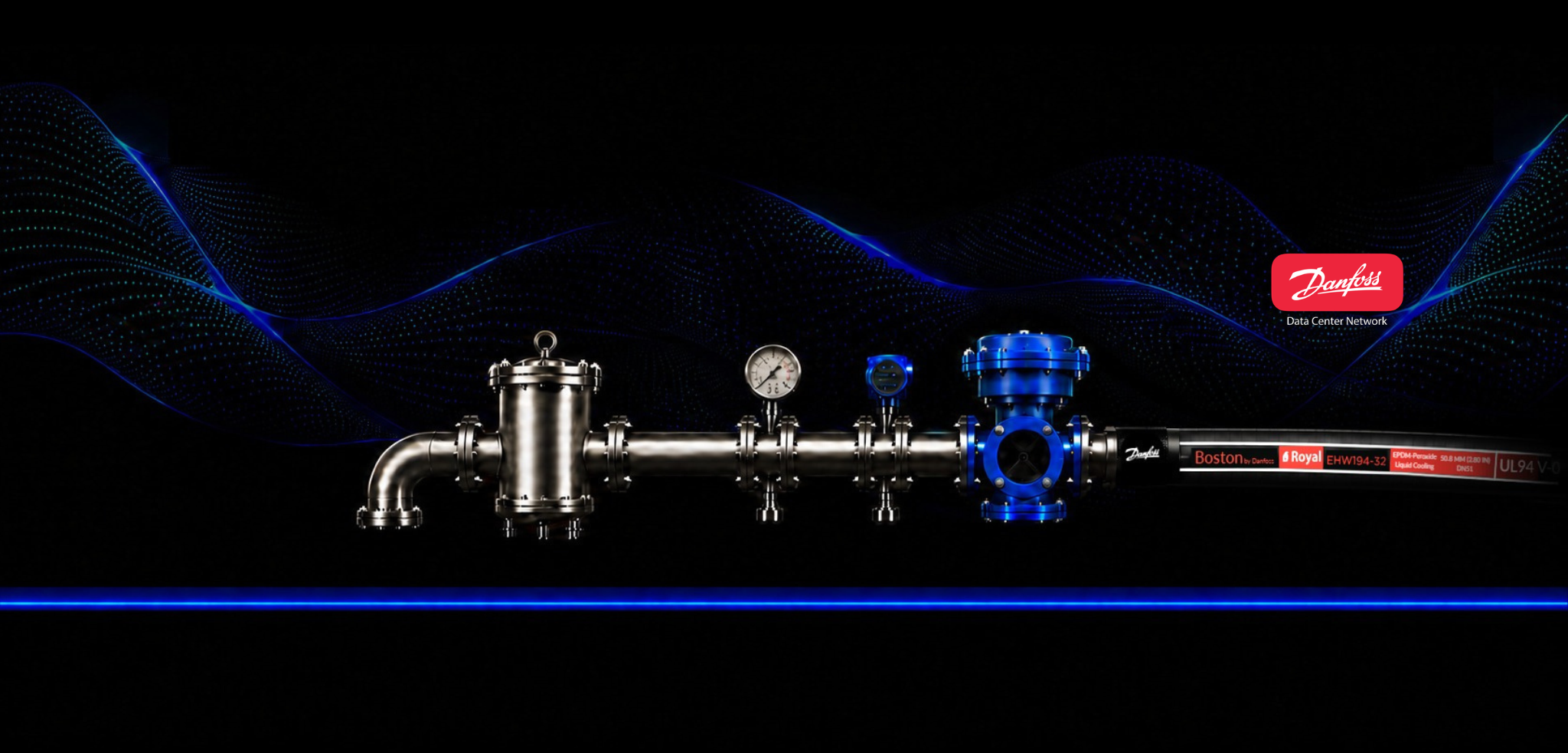

Source Loop and Facility Infrastructure
HydraCOOL provides engineered liquid cooling solutions across the entire cooling loop for data centers and AI factories, from facility water systems and primary pumps to Cooling Distribution Units and rack-level cooling. Our fluid-conveyance, filtration, heat-transfer, flow-control, and monitoring solutions support reliable coolant distribution, efficient thermal management, operational visibility, and long-term system performance.
PROTECT. MONITOR. CONTROL. MAINTAIN.
FILTRATION & COOLANT MONITORING
Clean coolant is essential for reliable system performance, protecting pumps, valves, and cooling equipment while minimizing downtime.
- Bag filtration systems
- Particle counters
- Fluid contamination sensors
- Coolant monitoring technologies
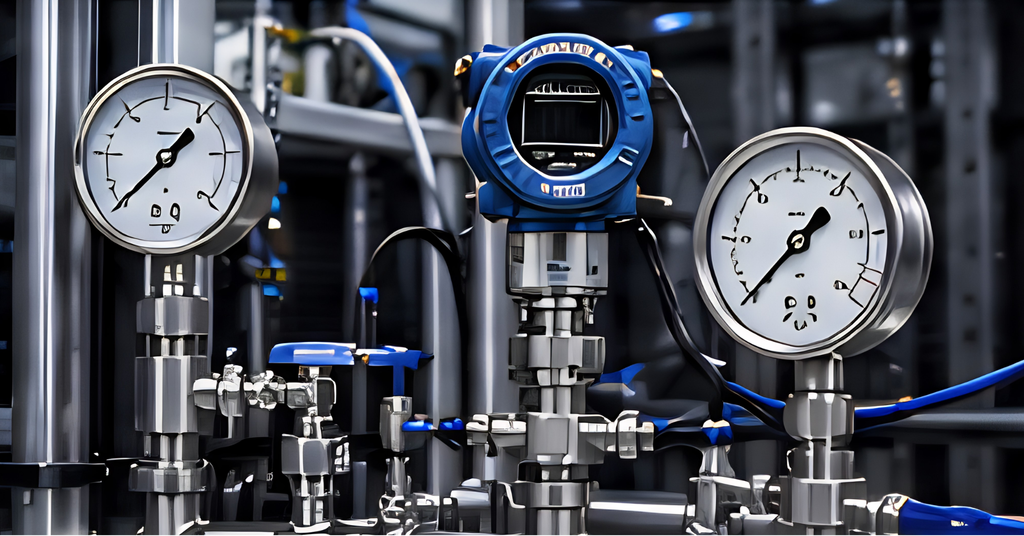
SENSING, MONITORING & DIAGNOSTICS
Monitoring cooling system performance helps operators maintain uptime. These systems support predictive maintenance and early fault detection.
- Pressure sensors
- Temperature sensors
- Flow monitoring
- Diagnostic measurement tools

VALVE AUTOMATION & FLOW CONTROL
Automated valves regulate coolant flow throughout cooling loops, enabling precise control, efficient system operation, and simplified maintenance.
- Automated butterfly valves
- Valve actuation systems
- Cooling loop isolation
- Remote system control
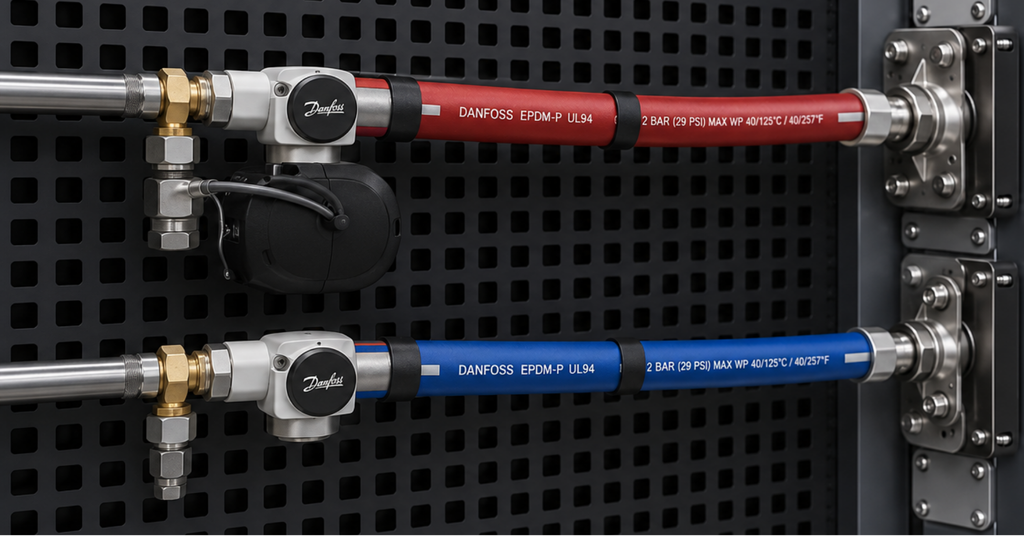
SERVICEABILITY & MAINTENANCE
Data center cooling systems require continuous uptime. These components enable hot-swap maintenance without interrupting cooling operations.
- Quick disconnect couplings
- Turnkey hose assemblies
- Isolation valves
- Instrumentation & Manifolds
FROM SOURCE LOOP TO RACK-LEVEL COOLING
Support Across the Full Data Center Cooling Loop
A reliable data center liquid cooling system connects facility infrastructure to rack-level cooling. HydraCOOL supports this path with components and application guidance for pumping, fluid conveyance, filtration, valve automation, and monitoring.
Cooling Loop Stages:
- Cooling Plant & Facility Water: Chillers, dry coolers, and heat exchangers reject heat and maintain facility water conditions.
- Primary Pumps: Pump and motor assemblies circulate facility water through the cooling loop.
- Cooling Distribution Units (CDUs): Transfer heat between facility and technology cooling loops while regulating coolant temperature, pressure, and flow.
- Row & Rack Cooling: Hoses, couplings, manifolds, and heat exchangers support coolant delivery and heat removal.
- Monitoring & Diagnostics: Sensors and diagnostic tools monitor performance and help identify cooling issues.
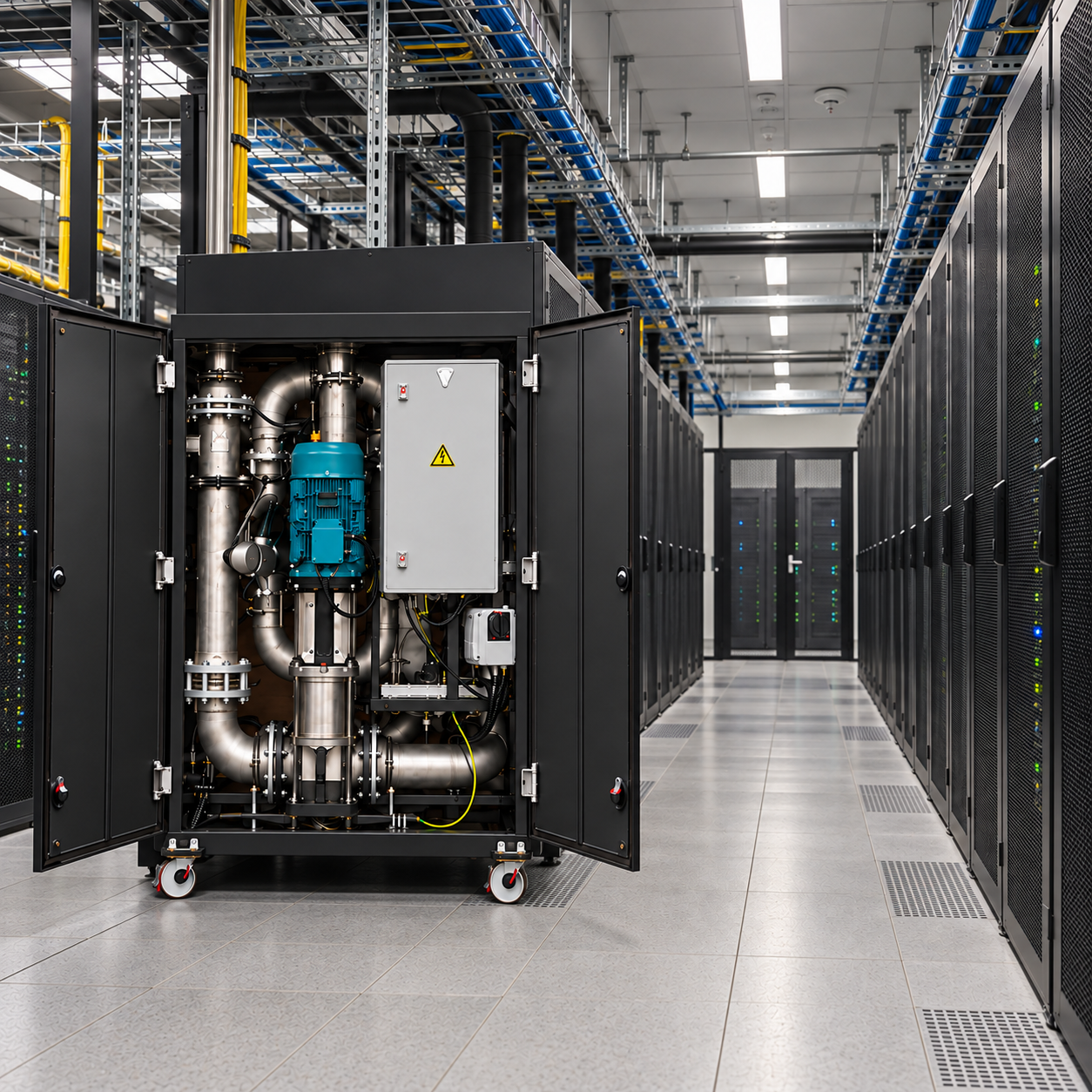

ENGINEERED SOURCE-LOOP COMPONENTS
Solutions for Reliable Facility-Side Cooling
Hydraquip’s HydraCOOL supports facility-side data center cooling with components for coolant circulation, heat transfer, flow isolation, and system monitoring.
- Danfoss Peroxide-cured EPDM Hose Assemblies & Quick Disconnects: EPDM-P hose and Danfoss FD83 couplings provide flexible coolant connections for equipment integration and maintenance.
- Isolation & Automated Valves: Control coolant flow and isolate equipment for service.
- Pumps & Motors: Circulate coolant through facility loops, with variable-speed options to match changing demand.
- Pipe Clamps & Supports: Secure piping, maintain alignment, and minimize movement.
- Heat Exchangers: Air-to-liquid, shell-and-tube, brazed-plate, and plate-and-frame options support heat transfer across cooling circuits.
- Monitoring & Diagnostics: Sensors, gauges, transmitters, and test points support commissioning, troubleshooting, and maintenance.
- Cooling Distribution Manifolds: Distribute coolant across multiple circuits with accessible connections and instrumentation.
The source loop circulates facility water between the cooling plant and downstream liquid cooling equipment. Common components include chillers, dry coolers, pumps, heat exchangers, valves, and distribution piping. It supplies the cooling capacity needed by equipment such as coolant distribution units (CDUs).
The source loop supplies facility water to the Cooling Distribution Unit. Inside the CDU, a heat exchanger typically transfers heat from the technology cooling system to the facility water system while keeping the two fluid circuits separated.
Common components include pumps, heat exchangers, filters, valves, sensors, manifolds, piping, hose assemblies, and quick-disconnect couplings. Aeroquip® by Danfoss DataCryo DC394 Hose supports source-line coolant conveyance, while Boston by Danfoss offers additional hose solutions for thermal management applications. Danfoss Hansen® couplings provide serviceable fluid connections.
Coolant filtration removes suspended particles and contamination that can restrict flow, contribute to component wear, and affect heat-transfer performance. Filters, strainers, and differential pressure monitoring help operators identify contamination and filter loading before they affect system performance.
Pressure, temperature, flow, and contamination can be monitored with sensors, gauges, transmitters, particle counters, test points, and diagnostic instruments. These measurements provide visibility for commissioning, troubleshooting, performance verification, and maintenance planning.
Automated valves regulate, direct, and isolate coolant throughout cooling circuits. When paired with actuators and system controls, they support flow adjustment, equipment isolation, and automated operating sequences. Selection depends on pressure, temperature, fluid compatibility, and flow requirements.
Quick-disconnect couplings create removable, service-friendly fluid connections. Low-spill designs can help reduce coolant loss and air entry when hoses or equipment are disconnected during planned maintenance. Solutions such as Danfoss Hansen® FD83 Couplings and Danfoss Hansen® Universal Quick Disconnect (UQD) connections support serviceable fluid connections in industrial and data center liquid cooling applications.
Yes. HydraCOOL can support component selection and integration for new facilities, capacity expansions, retrofits, and maintenance applications across the source loop and related liquid cooling infrastructure.