
As AI workloads and high-density computing increase cooling demands, data center operators are relying more heavily on liquid cooling systems to manage heat. These systems require dependable fluid conveyance, but limited space around coolant distribution units (CDUs), pumps, piping, and other equipment can make installing data center cooling hose challenging.
Two important considerations when selecting a liquid cooling hose are minimum bend radius and kink resistance. Both affect how easily a hose can be routed and whether it can maintain an adequate flow path without unnecessary strain.
The Aeroquip by Danfoss DataCryo DC394 was developed to address these challenges in large-diameter liquid cooling source lines. Its channeled construction, flexibility, and kink resistance help engineers accommodate tighter layouts while supporting consistent coolant circulation.
Hydraquip works with data center owners, OEMs, contractors, and engineering teams to select fluid conveyance solutions based on their specific cooling requirements.
What Is Hose Bend Radius and Why Does It Matter?
Hose bend radius describes how tightly a hose can curve during installation. The minimum bend radius is the smallest radius permitted by the manufacturer’s specifications under defined conditions.
When a data center cooling hose is bent more tightly than its specified limit, its internal structure may deform, potentially restricting coolant flow and placing additional stress on the hose and fittings.
For data center cooling hose, proper bend radius is especially important where hoses must be routed around pumps, valves, manifolds, and other equipment within limited space.
Selecting a hose with an appropriate minimum bend radius can help:
- Accommodate compact equipment layouts
- Reduce excessive bending stress
- Maintain an unobstructed coolant flow path
- Simplify installation and maintenance
- Reduce the risk of premature hose damage
Danfoss designed the DataCryo DC394 with a 1:1 bend-radius ratio to provide greater routing flexibility compared with conventional large-diameter hose designs. Engineers should still verify the manufacturer’s minimum bend-radius specification for the selected hose size and complete assembly.
How Kink Resistance Affects Coolant Flow
Kink resistance refers to a hose’s ability to resist localized collapse or deformation when bent.
When a hose kinks, its internal passage can become restricted, reducing the available flow area and increasing pressure loss. Depending on the severity and location of the restriction, this may affect coolant circulation and system performance.
In a liquid cooling system, maintaining the specified flow rate is important for transferring heat away from connected equipment.
Several factors influence kink resistance:
- Hose construction: Reinforcement and structural design help the hose maintain its shape during bending.
- Material flexibility: Flexible materials can make routing easier in confined spaces.
- Minimum bend radius: Following manufacturer specifications helps prevent damaging deformation.
- Installation practices: Proper routing, fitting alignment, clearance, and support reduce unnecessary strain.
The DataCryo DC394 features an engineered channeled construction designed to provide greater flexibility, lower bending force, and improved kink resistance in large-diameter liquid cooling applications.
What Makes the Aeroquip by Danfoss DataCryo DC394 Different?
Introduced by Danfoss in June 2026, the Aeroquip by Danfoss DataCryo DC394 is designed specifically for data center liquid cooling source lines.
As hose diameters increase to accommodate higher coolant flow requirements, routing and installation can become more difficult. The DC394 addresses these challenges through a flexible, kink-resistant design intended to simplify installation in compact equipment layouts.
According to Danfoss’s official product launch announcement, the hose incorporates several application-specific features.
DataCryo DC394 Product Specifications
| Feature | Published Specification |
| Application | Data center liquid cooling lines |
| Available inside diameters | 1–4 inches |
| Working pressure | 150 psi (10.5 bar) |
| Operating temperature | −40°F to 284°F (−40°C to 140°C)* |
| Bend-radius design | Danfoss-promoted 1:1 ratio |
| Inner tube and cover | Peroxide-cured EPDM |
| Reinforcement | Textile reinforcement and steel helix |
| Construction | Sulfur-free |
| Cover flammability | UL 94 V-0 rated |
| Identification | Red or blue laylines |
| Connections | Approved Danfoss fittings |
Key Benefits for Data Center Cooling Applications
Greater Routing Flexibility
The channeled design and reduced bending force help installers route larger-diameter hoses through constrained equipment layouts.
Improved Kink Resistance
The engineered construction helps reduce the potential for kink-related flow restrictions when the data center cooling hose is installed within its specified limits.
Fluid-System Material Considerations
The DC394 uses peroxide-cured, sulfur-free EPDM construction. Its sulfur-free formulation is intended to reduce potential sulfur-related contamination and corrosion concerns. Actual coolant compatibility must still be verified for the application.
Cover Flammability Performance
The data center cooling hose cover carries a UL 94 V-0 material flammability rating. This describes the cover material’s performance under the applicable test conditions, rather than certifying the entire assembled cooling system.
Supply and Return Identification
Red and blue identification laylines help distinguish coolant supply and return lines during installation and maintenance.
Together, these features make the DC394 an option for engineers evaluating large-diameter hoses for space-constrained liquid cooling installations.
Where Flexible Hoses Are Used in Data Center Cooling Systems
Flexible data center cooling hoses can be used in several areas of liquid cooling infrastructure, depending on the system design.
The DC394 is particularly relevant to larger-diameter source-line connections where routing flexibility and reduced bending force are important.
CDU Supply and Return Connections
Coolant distribution units may require flexible connections within compact mechanical layouts. Large-diameter hoses can help connect equipment while accommodating installation clearances and appropriate system movement.
For example, a CDU installation may have limited clearance between the unit’s connections and nearby piping or valves. A data center cooling hose with a smaller approved minimum bend radius may provide additional routing options without requiring an overly long assembly or an unnecessarily complex connection layout.
However, the complete installation must still account for minimum bend radius, fitting clearance, hose movement, operating pressure, and applicable support requirements.
Pump and Heat Exchanger Connections
Flexible data center cooling hose assemblies may also be used where equipment connections require routing flexibility or accommodation for defined movement. Properly selected assemblies can help simplify installation, although vibration isolation and movement requirements must be evaluated separately.
Facility Cooling Distribution
In some cooling architectures, larger-diameter flexible hoses connect sections of facility cooling infrastructure or modular equipment packages.
Data center cooling hose selection must account for the required flow rate, allowable pressure drop, coolant chemistry, operating temperature, and the applicable connection specifications.
How to Select the Right Data Center Liquid Cooling Hose
Bend radius and kink resistance are important, but they should never be the only criteria used to select a data center cooling hose.
Engineers should evaluate the complete application before choosing a fluid conveyance solution.
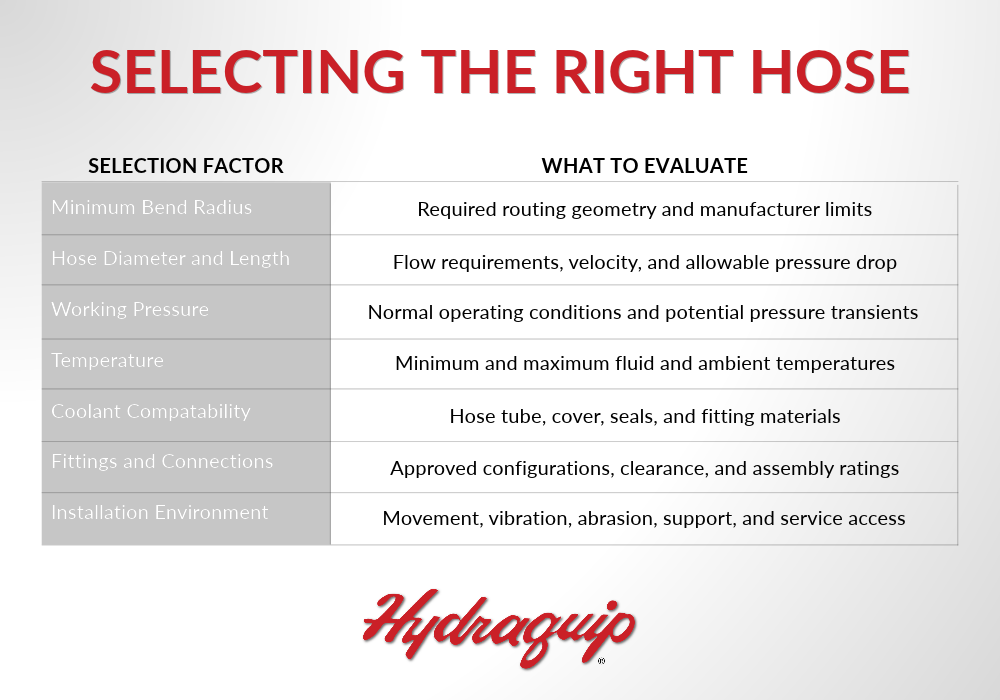
For example, a data center cooling hose may offer excellent flexibility but still be unsuitable if its working pressure, fluid compatibility, or fitting configuration does not meet the system requirements.
The pressure drop through an assembly should also be evaluated based on its internal diameter, length, flow rate, coolant properties, bends, and connection geometry.
Selecting the correct hose and fittings together helps support efficient installation and dependable long-term operation.
How Hydraquip Supports Data Center Fluid Conveyance
Successful liquid cooling installations depend on selecting components that work together throughout the cooling loop.
As a Danfoss partner, Hydraquip helps customers evaluate hose selection, fitting compatibility, operating conditions, routing requirements, and assembly configurations for fluid conveyance applications.
Through HydraCOOL, Hydraquip also supports data center liquid cooling systems with pumps, valves, filtration, instrumentation, hose assemblies, couplings, and other engineered components.
For customers requiring custom coolant distribution units or integrated cooling packages, Hydraquip’s sister company, Supreme Integrated Technology, provides additional engineering and system integration capabilities.
This combination allows customers to access fluid conveyance expertise alongside broader liquid cooling system support.
Frequently Asked Questions About Data Center Cooling Hoses
What is the minimum bend radius of a cooling hose?
The minimum bend radius is the smallest radius at which a hose can be installed under the manufacturer’s specified conditions without exceeding its design limits. It varies by hose construction, diameter, and product specifications.
What happens if a liquid cooling hose kinks?
A kink can reduce the hose’s internal flow area, increase pressure drop, and interfere with coolant circulation. Severe kinking may also damage the hose structure and require replacement.
What makes the Danfoss DataCryo DC394 different?
The DC394 uses an engineered channeled construction designed to provide greater flexibility, reduced bending force, and improved kink resistance. Danfoss also promotes a 1:1 bend-radius ratio for the product, making it particularly relevant to large-diameter source-line routing.
Does a flexible hose automatically improve coolant flow?
No. Flexibility can simplify routing and help prevent installation-related restrictions, but actual flow performance depends on hose diameter, length, coolant properties, system pressure, fittings, and the overall cooling system design.
How do you choose the right hose for a CDU?
Evaluate the required flow rate, pressure, temperature, coolant compatibility, bend radius, hose length, fitting connections, and available installation space. The complete hose assembly must meet the system’s operating and maintenance requirements.
Find the Right Cooling Hose Solution with Hydraquip
As data center cooling infrastructure becomes more complex, hose selection plays an important role in installation efficiency, coolant distribution, and equipment serviceability.
The Aeroquip by Danfoss DataCryo DC394 offers a flexible, kink-resistant solution for large-diameter liquid cooling source lines, helping engineers address routing challenges in space-constrained environments.
Need help selecting a hose for your data center cooling application? Hydraquip can help evaluate bend radius, coolant compatibility, pressure requirements, fitting selection, and assembly configuration.
Contact Hydraquip to discuss the DataCryo DC394 and other fluid conveyance solutions for your next project.