

Danfoss variable frequency drives support a wide range of motor-driven applications, from pumps and HVAC equipment to production machinery, marine systems, and heavy industrial processes.
Three names customers frequently encounter within the Danfoss Drives portfolio are VLT®, VACON®, and iC7™. Although all three include technologies that control motor speed and torque, they are not simply interchangeable versions of the same drive. Each family has its own product history, application strengths, available configurations, and role within the broader Danfoss portfolio.
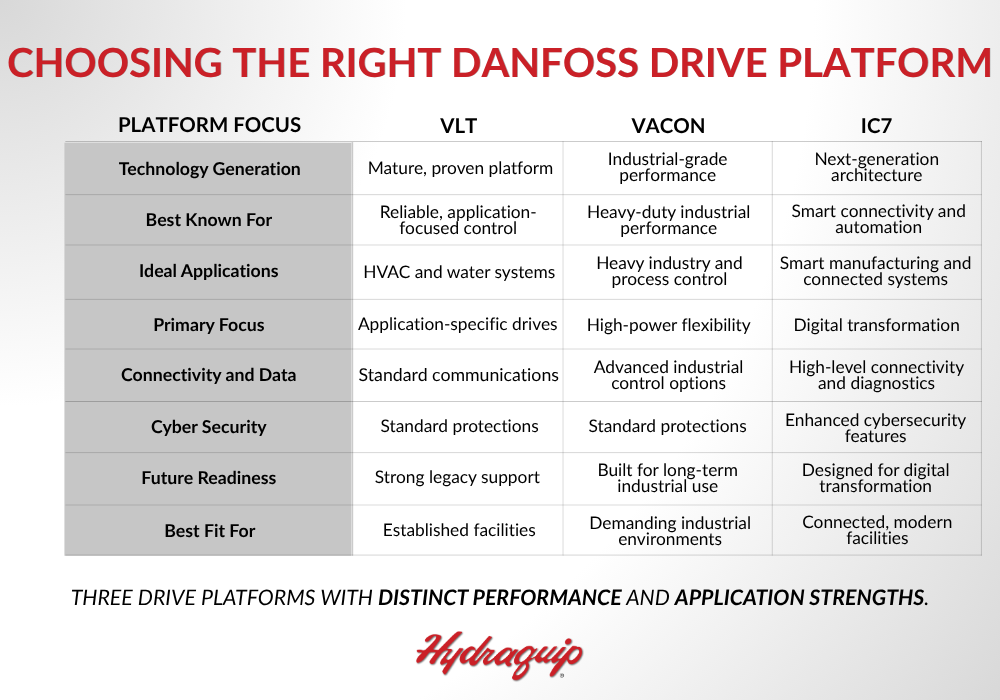
VLT drives are known for established, application-focused solutions across areas such as industrial automation, water and wastewater, and HVAC. VACON drives include options designed for flexible and demanding industrial applications. The newer iC7 series introduces a modular drive platform built around advanced motor control, connectivity, system integration, and evolving automation requirements.
Understanding these differences can help engineers, maintenance teams, OEMs, and facility leaders narrow down their options. The final selection, however, should always be based on the motor, load, power range, operating environment, control requirements, existing equipment, and long-term plans for the system.
At Hydraquip Electric Systems, our team helps customers evaluate, select, integrate, commission, and support Danfoss drive technologies for new systems, retrofits, and modernization projects.
What Does a Variable Frequency Drive Do?
A variable frequency drive, or VFD, controls an electric motor by adjusting the frequency and voltage supplied to it. This allows motor output to better match the needs of the application instead of running at full speed in every operating condition.
Depending on the application, a properly selected VFD can help:
- Control motor speed and torque
- Improve process consistency
- Reduce mechanical stress during acceleration and deceleration
- Support energy savings in variable-load applications
- Improve system monitoring and diagnostics
- Extend the useful life of connected equipment
- Integrate the motor into a larger automation system
The drive family is only one part of the decision. Power requirements, load characteristics, motor type, communications, safety functions, enclosure needs, harmonics, environmental conditions, and lifecycle support must also be considered.
What Is the VLT® Drive Family?
VLT is one of Danfoss’s most established drive brands. Products within the VLT family are designed around specific motor-control and application needs, making them familiar options for many industrial and commercial facilities.
Examples include the VLT® AutomationDrive FC 301/FC 302, which is designed for variable-speed control of asynchronous and permanent-magnet motors, and the VLT® AQUA Drive FC 202, which is designed for motor-driven water and wastewater applications.
VLT drives are commonly valued for:
- Established application experience
- Familiar setup and commissioning processes
- Application-specific functions
- A substantial installed base
- Support for new installations and retrofit projects
- Broad use across industrial and commercial systems
Common Applications for VLT Drives
Depending on the specific model, VLT drives may be used for:
- Pumps and fans
- Water and wastewater systems
- HVAC and building systems
- Conveyors
- Manufacturing equipment
- Machine automation
- Material handling
- General industrial motor control
VLT may be a strong choice when an established application-focused product meets the system’s operating, integration, and lifecycle requirements.
What Is the VACON® Drive Family?
VACON drives are widely associated with industrial flexibility and motor control in demanding applications. The family includes products designed for applications that may require dynamic performance, larger power ranges, system-drive configurations, or rugged operation.
For example, the VACON® NXP Air Cooled is positioned for applications requiring robust and dynamic performance and is available in configurations supporting power ranges up to 2 MW. Danfoss also offers VACON solutions in other configurations, including liquid-cooled systems for applications where high power density or limited cooling space must be considered.
VACON drives are commonly associated with:
- Flexible industrial control
- Demanding operating environments
- Higher-power applications
- Dynamic motor performance
- Multiple enclosure and cooling configurations
- Complex machine and process requirements
Common Applications for VACON Drives
Depending on the product and configuration, VACON drives may be considered for:
- Marine and offshore equipment
- Heavy industrial machinery
- Material handling
- Process manufacturing
- Pumps, compressors, and conveyors
- Mining and minerals
- Oil and gas applications
- High-power or system-drive applications
VACON may be a strong fit when the application requires industrial flexibility, robust performance, or a configuration designed around demanding operating conditions.
What Is the iC7™ Drive Platform?
The iC7 series is Danfoss’s newer drive and power-conversion platform. It was developed to support advanced motor control, modular system design, connectivity, functional safety, and modern automation requirements.
The iC7 portfolio includes application-focused products such as:
- iC7-Automation
- iC7-Aqua
- iC7-HVACR
The broader iC7 series also includes solutions developed for areas such as marine systems, hybrid power conversion, electrification, energy storage, and other advanced applications.
Depending on the product, iC7 capabilities may include:
- Modular control architecture
- Selectable communication protocols
- Advanced motor-control performance
- Integrated functional safety features
- Expanded processing and sensing capabilities
- Condition-based monitoring support
- Flexible software and hardware options
- More compact system design
- Support for connected and data-driven operations
For example, Danfoss describes iC7-Automation as a modular platform with selectable communication protocols and Safe Torque Off at SIL3 as standard. The iC7-Aqua is designed specifically for water and wastewater applications, while iC7-HVACR addresses HVAC and refrigeration applications.
Common Applications for iC7 Drives
Depending on the specific iC7 product, applications may include:
- Modern industrial automation
- Connected manufacturing systems
- Water and wastewater infrastructure
- HVAC and refrigeration
- Marine and offshore systems
- Energy storage and hybrid power systems
- High-performance machinery
- Equipment designed around future expansion or increased data access
iC7 may be especially relevant when a project prioritizes advanced integration, modularity, functional safety, connectivity, or a newer system architecture.
Key Differences Between VLT, VACON, and iC7
Application Focus
VLT products are often designed around recognizable applications such as automation, HVAC, and water or wastewater systems.
VACON products are commonly associated with flexible industrial control, dynamic applications, and demanding operating environments.
iC7 extends Danfoss’s drive offering with a newer modular architecture designed for modern automation, application-specific functionality, connected systems, and power-conversion needs.
These categories overlap. The application should be evaluated against the features of the individual drive rather than selected by family name alone.
Platform Architecture
Many VLT and VACON products have long operating histories and substantial installed bases. That can be valuable when a facility needs to maintain compatibility, standardize spare parts, or replace an existing drive.
The iC7 series uses a newer modular architecture intended to support additional processing capability, configurable functions, communications, and future system development.
Connectivity and Data
VLT, VACON, and iC7 drives can all be integrated into control systems, and Danfoss provides PLC libraries for products across all three families.
The newer iC7 platform places greater emphasis on connected operation, expanded processing, advanced sensing, and data-driven features. However, communications requirements must still be reviewed at the individual product level.
Functional Safety
Available safety functions vary by drive and configuration. Certain iC7 products include advanced safety capabilities as part of the platform. For example, iC7-Automation includes Safe Torque Off rated to SIL3 as standard.
The required safety architecture should always be determined through a proper risk assessment and review of the exact product documentation.
Cybersecurity
Cybersecurity is becoming an important consideration as drives connect to industrial networks and operational technology systems.
The iC7 platform was developed with modern connectivity and security requirements in mind. That does not mean the drive alone secures the complete system. Network design, access control, software management, system configuration, and facility cybersecurity practices remain essential.
Lifecycle and Modernization
A newer platform is not automatically the correct choice for every retrofit, and an established platform is not automatically outdated.
Some VLT and VACON products remain active, while others have moved into later lifecycle stages. Danfoss maintains a separate list of legacy drives and offers lifecycle and retrofit support for products that are no longer part of the active portfolio.
Before replacing an existing drive, facilities should identify:
- The exact model and lifecycle status
- Motor and load requirements
- Existing communications
- Control logic and I/O
- Physical dimensions and enclosure requirements
- Safety functions
- Harmonic requirements
- Available replacement products
- Programming and commissioning needs
- Spare-parts and service strategy
Is iC7 Replacing VLT and VACON?
There is not one simple answer that applies to every product.
iC7 represents a newer generation of Danfoss drive technology, and certain customers may move from an older product to an iC7 solution as part of a new design or modernization project. However, Danfoss continues to offer active products within the VLT and VACON families, and different products serve different applications and power requirements.
Some individual VLT and VACON models have reached limited or inactive lifecycle stages, but that does not mean every VLT or VACON drive has been discontinued.
The correct replacement or migration path should be confirmed for the exact model and application.
Which Danfoss Drive Platform Is Right for Your Application?
The best drive is not necessarily the newest product or the product with the longest feature list. It is the one that meets the application’s technical requirements while supporting reliable operation, practical maintenance, and long-term serviceability.
Important selection factors include:
- Motor type and horsepower
- Voltage and power range
- Load profile
- Speed and torque requirements
- Acceleration and deceleration needs
- Control method
- Communication protocol
- I/O requirements
- Safety functions
- Harmonic performance
- Enclosure and cooling requirements
- Ambient temperature and environmental conditions
- Space limitations
- Existing controls and installed equipment
- Modernization goals
- Lifecycle support
A water facility replacing an existing pump drive may have very different priorities from an OEM designing connected production equipment or a marine customer controlling a high-power system.
For applications requiring complete electrified powertrains, Danfoss also offers the Editron platform for permanent magnet motors and power converters. While Editron products are not variable frequency drives, they complement Danfoss Drives in electrification and hybrid power applications.
How Hydraquip Electric Systems Supports Danfoss Drive Projects
Choosing the drive is only one part of a successful motor-control project. The drive must also be sized, configured, integrated, programmed, commissioned, and supported correctly.
Hydraquip Electric Systems can help customers with:
- Application review
- VFD selection and sizing
- VLT, VACON, and iC7 product evaluation
- Legacy drive replacement planning
- Drive configuration and programming
- Control panel and electrical integration
- PLC and communication integration
- Startup and commissioning
- Troubleshooting
- System modernization
- Ongoing technical support
Our team looks beyond the drive model to understand the motor, machine, process, controls, operating environment, and long-term goals for the system.
Whether you are maintaining an existing VLT or VACON installation, replacing a legacy drive, or evaluating an iC7 platform for a new system, Hydraquip can help determine the right path for the application.
Contact Hydraquip Electric Systems to discuss your Danfoss drive application, upgrade, or integration project.
Frequently Asked Questions About VLT, VACON, and iC7 Drives
What is the main difference between VLT, VACON, and iC7 drives?
VLT includes established, application-focused Danfoss drive products. VACON includes flexible industrial drives used in many demanding and higher-power applications. iC7 is a newer modular drive and power-conversion platform designed around advanced motor control, connectivity, safety, and modern system integration.
The exact differences depend on the individual products being compared.
Is iC7 replacing every VLT drive?
No. Danfoss continues to offer active VLT products. Some older VLT models have reached later lifecycle stages and may have newer recommended successors, but the correct replacement depends on the specific model and application.
Is iC7 replacing every VACON drive?
No. Danfoss continues to offer active VACON products for a range of industrial applications. Some individual products may eventually have newer successors, but replacement recommendations must be evaluated by model, power range, and application.
Which Danfoss drive is best for water and wastewater applications?
The VLT AQUA Drive FC 202 and iC7-Aqua are both designed for water-related applications. The better option depends on factors such as the existing installation, motor requirements, system architecture, connectivity, harmonics, lifecycle plans, and project specifications.
Which Danfoss drive is best for HVAC applications?
Danfoss offers application-focused HVAC solutions within both the VLT and iC7 portfolios. Product selection should consider the equipment, power range, control functions, communications, system design, and whether the project is a new installation or retrofit.
Which drive family is best for heavy industrial applications?
VACON drives are commonly used in demanding industrial and high-power applications. Certain VLT and iC7 products can also support challenging industrial duties. The load, environment, control performance, power level, and required configuration should determine the selection.
Does iC7 provide better connectivity?
The iC7 platform was designed with modern connectivity, modularity, processing, and system integration in mind. However, VLT and VACON products also support industrial communications. The required protocols and functionality should be verified for the individual drive.
Can Hydraquip help replace a legacy Danfoss drive?
Yes. Hydraquip Electric Systems can help identify the existing drive, review its lifecycle status, evaluate replacement options, and support sizing, integration, programming, startup, and commissioning.
How do I determine which Danfoss drive is right for my application?
Start with the motor, load, power range, operating environment, control requirements, communications, safety needs, and long-term lifecycle strategy. Hydraquip Electric Systems can review these factors and help recommend an appropriate drive and integration approach.