

Artificial intelligence is reshaping data center infrastructure. As AI models become larger and rack densities continue to increase, traditional air-cooling systems are reaching their practical limits. Today’s high-performance processors generate significantly more heat than previous generations, making liquid cooling one of the most effective ways to support performance, reduce energy consumption, and protect critical IT equipment.
At the center of many liquid cooling systems is the Cooling Distribution Unit, or CDU. A CDU helps manage coolant temperature, pressure, and flow within the design requirements of the technology cooling loop. However, CDU performance does not depend on the CDU alone. It depends on every supporting component connected to the liquid cooling system.
Pumps, valves, filtration systems, hose assemblies, heat exchangers, sensors, instrumentation, and monitoring technologies all work together to maintain stable coolant circulation and support long-term uptime. If one component underperforms, the entire cooling loop can be affected.
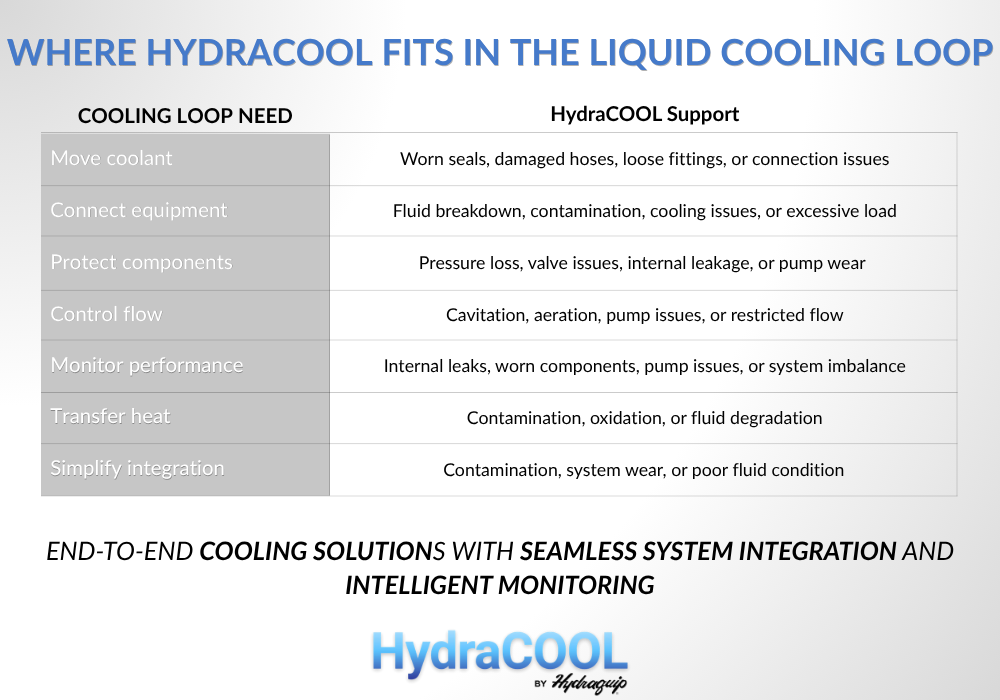
HydraCOOL, powered by Hydraquip, supports every stage of the liquid cooling loop with engineered components that help data centers operate efficiently and with greater confidence. From source loop infrastructure to rack-level cooling, HydraCOOL delivers solutions that help customers build liquid cooling systems for today’s AI workloads and tomorrow’s expanding compute demands.
What Is a Cooling Distribution Unit?
A CDU is the interface between a facility’s primary cooling system and the secondary coolant loop that removes heat from IT equipment.
Rather than sending facility water directly through sensitive servers, the CDU transfers heat between separate cooling loops using heat exchangers, pumps, sensors, and control systems. This helps protect expensive computing hardware while maintaining the operating conditions required for high-density applications.
A CDU may support several important functions, including:
- Regulating coolant temperature
- Maintaining required system pressure
- Controlling coolant flow rates
- Separating facility water from server cooling loops
- Supporting direct-to-chip and rear door heat exchanger cooling technologies
- Providing monitoring and diagnostic data for operators
As rack power densities continue to rise, CDUs are becoming essential in AI data centers, hyperscale facilities, enterprise computing environments, and high-performance computing applications.
Why the Entire Liquid Cooling Loop Matters
Although the CDU plays a central role, it cannot perform effectively without the surrounding infrastructure.
A liquid cooling system is made up of interconnected components that must work together. Coolant may move from the facility or source loop through pumps, valves, filtration equipment, monitoring devices, hose assemblies, and heat exchangers before reaching the CDU and ultimately the server racks.
If one part of the loop is not performing correctly, the impact can spread throughout the system.
For example:
- Contaminated coolant can restrict heat exchangers and damage pumps.
- An inaccurate pressure sensor can make troubleshooting more difficult.
- A leaking hose assembly can reduce cooling capacity and increase maintenance needs.
- A malfunctioning valve can restrict flow and create uneven cooling across equipment.
- A loaded filter can increase pressure drop and reduce system efficiency.
Because every component contributes to overall performance, successful liquid cooling systems should be engineered as complete ecosystems rather than isolated products.
Supporting the Source Loop
Every liquid cooling system starts with a source of heat rejection.
The facility or source loop may include chillers, cooling towers, dry coolers, heat exchangers, pumps, valves, and piping that remove heat from the data center and deliver conditioned water to the CDU. The exact configuration depends on the facility design, climate, operating requirements, and cooling strategy.
Because this infrastructure operates continuously, component performance and serviceability are critical. A source-loop issue can affect cooling capacity across the entire facility.
HydraCOOL supports source loop infrastructure with engineered components including:
- Primary pump systems
- Heat exchangers
- Valve isolation systems
- Process cooling distribution manifolds
- Pipe support systems
- Pressure and temperature instrumentation
- Monitoring and diagnostic equipment
Together, these components help operators maintain efficient coolant circulation and support stable long-term operation.
Reliable Fluid Conveyance Starts with Quality Connections
Moving coolant safely and efficiently throughout a data center requires dependable fluid conveyance solutions.
HydraCOOL supplies EPDM-P hose assemblies designed for liquid cooling applications where flexibility, durability, and long service life are important. These assemblies can be paired with FD83 quick disconnect couplings and UQD couplings to help connect and disconnect cooling equipment more efficiently.
Properly selected low-spill or spill-free quick disconnect couplings can reduce coolant loss during connection and disconnection while supporting cleaner, more serviceable installations.
Quick disconnect technology offers several advantages:
- Faster equipment installation
- Easier maintenance access
- Reduced need to drain large sections of the cooling loop
- Secure coolant connections
- Improved scalability as cooling capacity expands
As AI deployments continue to grow, modular hose assemblies and quick disconnect systems make it easier to add equipment and support future expansion without unnecessary redesign of the cooling infrastructure.
Pump Systems That Keep Coolant Moving
Even the most advanced CDU cannot perform properly without consistent coolant circulation.
Pump systems move coolant throughout the liquid cooling loop while supporting the flow rates required for efficient heat removal. If pump performance declines, the system may experience reduced flow, unstable temperatures, or increased energy use.
HydraCOOL supplies integrated pump and motor assemblies designed to support facility water systems and secondary cooling loops. Variable speed drives can further improve system performance by adjusting pump output based on cooling demand.
This can provide several operational advantages:
- Stable coolant flow
- Improved temperature consistency
- Lower energy consumption
- Reduced operating costs
- Longer equipment life
- Better response to changing workloads
As AI workloads fluctuate, variable speed pumping can help maintain cooling performance without requiring pumps to operate at full capacity when demand is lower.
Filtration Protects Components Throughout the Cooling Loop
Coolant quality has a direct impact on system performance and equipment life.
Particles, debris, corrosion, and other contaminants can accumulate inside liquid cooling systems over time. If not addressed, contamination can reduce heat transfer efficiency, damage pumps, restrict coolant flow, interfere with valve operation, and shorten the life of connected equipment.
Filtration should be selected based on the specific loop, fluid chemistry, component sensitivity, flow rate, pressure requirements, and OEM cleanliness recommendations. In facility-water systems, filtration may also need to work alongside water treatment programs designed to manage corrosion, scale, biological growth, and chemistry control.
HydraCOOL supports coolant cleanliness through solutions that may include:
- Bag filtration systems
- Particle counters
- Fluid contamination sensors
- Coolant monitoring technologies
- Filtration products selected for the application requirements
Maintaining clean coolant helps protect the CDU as well as pumps, heat exchangers, valves, hose assemblies, and rack-level cooling equipment. For AI facilities where uptime is critical, effective contamination control is one of the most practical ways to reduce maintenance risk and support system performance.
Precision Monitoring Helps Prevent Downtime
In high-density data centers, visibility into cooling system performance is just as important as the cooling equipment itself. Operators need accurate, real-time data to confirm coolant is flowing properly, temperatures remain within acceptable limits, and potential issues are identified early.
HydraCOOL provides sensing, monitoring, and diagnostic solutions that help operators evaluate cooling system performance.
These solutions may include:
- Pressure sensors
- Temperature sensors
- Flow monitoring devices
- RTD temperature sensors
- Instrumentation manifolds
- Diagnostic measurement tools
For example, a gradual increase in pressure drop across a filter may indicate that it is becoming loaded and should be replaced before it restricts coolant flow, or bypasses the filter element completely. Unexpected temperature changes or flow fluctuations may point to pump issues, valve problems, or developing restrictions.
Rather than relying only on reactive maintenance after a problem occurs, monitoring technologies help operators make more informed maintenance decisions, improve planning, and reduce the risk of unplanned interruptions.
Valve Automation Improves Flow Control and Serviceability
Modern liquid cooling systems require more than simply moving coolant from one location to another. Operators also need the ability to control flow, isolate equipment during service, and adjust system performance as operating conditions change.
HydraCOOL supports these requirements with valve automation and flow control solutions for liquid cooling applications.
Available solutions may include:
- Automated butterfly valves
- Valve actuation systems
- Cooling loop isolation valves
- Remote valve control systems
Automated valves help regulate coolant flow throughout the system while reducing the need for manual intervention. They can also isolate specific sections of the cooling loop, allowing maintenance to be performed on selected equipment without shutting down the entire system.
Combined with monitoring systems and instrumentation, automated valves give operators greater flexibility to manage cooling performance as workloads change.
Heat Exchangers Support Efficient Thermal Management
Heat exchangers play a critical role in liquid cooling systems by transferring heat between separate coolant circuits while preventing the fluids from mixing.
Within many CDUs, heat exchangers separate facility water from the secondary coolant loop that circulates through IT equipment. This configuration supports efficient heat removal while helping protect sensitive hardware.
HydraCOOL can support applications involving brazed plate, plate-and-frame, shell-and-tube, rear door, air-to-liquid, and other heat exchanger technologies depending on the cooling architecture, space requirements, service needs, and thermal load.
As rack power densities increase, efficient heat transfer becomes even more important. Properly selected heat exchangers help maintain stable operating temperatures, improve cooling efficiency, and support overall system performance.
Rack-Level Cooling Requires Dependable Components
The final stage of the liquid cooling loop is where heat is removed directly from IT equipment.
Whether using direct-to-chip cooling or rear door heat exchangers, rack-level cooling requires dependable fluid conveyance, accurate sensing, and service-friendly connections.
HydraCOOL supports rack-level cooling with:
- EPDM-P flexible cooling hose assemblies
- FD83 and UQD quick disconnect couplings
- RTD temperature monitoring systems
- Rear door heat exchangers
In systems designed for serviceability, quick disconnect couplings can support faster rack or component replacement without draining the entire loop. This can reduce maintenance time while simplifying equipment upgrades and service activities.
Reliable rack-level components also support future expansion. As organizations deploy additional AI hardware, modular cooling connections allow new equipment to be integrated more efficiently.
Complete Liquid Cooling Solutions for AI Data Centers
As liquid cooling adoption grows, organizations need partners that understand the complete cooling ecosystem rather than individual products alone.
HydraCOOL supports every stage of the liquid cooling loop with engineered components designed to improve performance, serviceability, and long-term operation.
Our capabilities include:
- Fluid conveyance assemblies
- CDU support components
- Pump and motor assemblies
- Variable speed drives
- Heat exchangers
- Valve automation and flow control
- Pressure, temperature, and flow instrumentation
- Filtration and contamination monitoring
- Pipe support systems
- Monitoring and diagnostic technologies
For customers seeking a more integrated solution, custom turnkey liquid cooling skids are available through our sister company, Supreme Integrated Technology. These engineered packages combine multiple cooling components into a single, application-specific system designed to simplify installation and support long-term operation.
Whether supporting a new AI data center, expanding an existing facility, or upgrading liquid cooling infrastructure, HydraCOOL provides the components and engineering expertise needed to build dependable cooling systems from the source loop to the server rack.
Contact Hydraquip today to learn more about our CDU capabilities for data center liquid cooling applications.
Frequently Asked Questions
What is a Cooling Distribution Unit?
A Cooling Distribution Unit, or CDU, is a system that transfers heat between facility cooling water and a secondary liquid cooling loop serving IT equipment. It helps manage coolant temperature, pressure, and flow within the design requirements of the system.
Why are CDUs important for AI data centers?
AI servers generate significantly more heat than traditional computing equipment. CDUs help support direct-to-chip cooling, rear door heat exchangers, and other liquid cooling technologies by managing coolant conditions for high-density computing environments.
What components are needed to support a CDU?
A complete liquid cooling system may include pump systems, heat exchangers, filtration equipment, hose assemblies, quick disconnect couplings, pressure and temperature sensors, flow monitoring devices, valve automation, and coolant monitoring technologies. Each component contributes to the performance and serviceability of the overall cooling loop.
How do quick disconnect couplings improve liquid cooling maintenance?
Quick disconnect couplings allow technicians to disconnect cooling equipment more efficiently. Properly selected low-spill or spill-free couplings can reduce coolant loss, simplify maintenance, and reduce the need to drain large sections of the cooling system.
Why is coolant filtration important?
Filtration helps remove particles and contaminants that can damage pumps, restrict heat exchangers, interfere with valves, and reduce cooling efficiency. Filtration should be selected based on the specific cooling loop, fluid chemistry, flow rate, component sensitivity, and cleanliness requirements.
How does HydraCOOL support liquid cooling systems?
HydraCOOL supplies engineered components that support the full liquid cooling loop, including fluid conveyance assemblies, pump systems, valve automation, heat exchangers, filtration solutions, instrumentation, monitoring technologies, and custom turnkey cooling skids. By supporting each stage of the cooling process, HydraCOOL helps customers build liquid cooling systems for today’s high-density AI infrastructure and future compute demands.